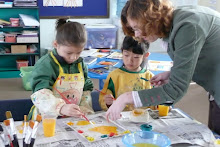
This blog started as something I was required to do for a master's course but I hope I can keep it up with small but funny posts about my upcoming first graders. I can't believe it will be 4 years of first grade when the bell rings this fall and 6 years of teaching. I feel OLD. But I love this time of year when everything is so NEW.
Wednesday, August 4, 2010
Anticipation of Fall
I'm on holiday right now in my uncle's home in Devon, UK. I love it here. I just flew back here to rest before I have my birthday (27...wait, I don't remember that I would getting this old!) and then head back to Beijing for another school year. I've been to England, France and Switzerland for my school break and now my mind is turned towards school again. It took everything in me not to buy office supplies in the stores in Switzerland... knowing that I would buy way too much to carry back in my rucksack and also paying way more than I needed too for certain items. I still might buy some highlighters anyway!

Tuesday, May 25, 2010
Why the Sun is so Hot
Yes, I’m the girl who carries an umbrella and uses it more for a sun shade than I do for rain. Today it was SO hot outside. I sat down under my umbrella during recess duty and immediately had 4 of my first grade girls gravitate to my side to also seek shelter from the sun’s harsh rays. I asked them why it was so hot outside and got a couple of great answers:
“Because maybe we are getting closer to the sun like the Equator country people”
“Because yesterday the sun was not feeling well so now it feels so much better and it is happy and dancing and feel much better so it is hot hot hot!”
“Because maybe we are getting closer to the sun like the Equator country people”
“Because yesterday the sun was not feeling well so now it feels so much better and it is happy and dancing and feel much better so it is hot hot hot!”
Wednesday, April 28, 2010
Workshop 8 Blog
I put up some new photos that I got developed last week in my classroom. My students immediately noticed that there was new photos taped up to my bookshelf. This led them into a series of 'Good morning' questions about why, and when, and who was in the photos. Then they asked 'Miss L, why do you wear different clothes everyday? Why do you have so many different beautiful earrings?'.
Change. It's all around us. ESPECIALLY when it comes to technology, and where there is technology right behind it is some way to integrate that technology into our classrooms and to make it 'educational' for students and easier for teachers. I'm ALL ABOUT jumping on that bandwagon. As I learn more about technology, it gets easier and easier to both naturally use in the classroom and outside the classroom.
So, here we are at the end of my Technology in Education course. I learned WAY more than I think it is possible to ever apply. I've applied so much of it already. My next big task is to find that 'perfect' balance in my instruction.
• What teaching strategies used during this course compliment integration of technology?
Discussion, collaboration, multi media applications/programs, textbooks with interactive CDs and using the internet are just a few of the ways this class compliments integration of technology.
• How do you personally define technology integration after completing this course?
I personally define technology integration as the process of well balanced use of available technology into the classroom on a daily basis. When we use technology, we become more familiar with how we can use it in different ways. The state that results from using technology in the classroom is that our students are receiving balanced education through a diversity of ways. Technology also allows them to process the information they are constantly learning.
Change. It's all around us. ESPECIALLY when it comes to technology, and where there is technology right behind it is some way to integrate that technology into our classrooms and to make it 'educational' for students and easier for teachers. I'm ALL ABOUT jumping on that bandwagon. As I learn more about technology, it gets easier and easier to both naturally use in the classroom and outside the classroom.
So, here we are at the end of my Technology in Education course. I learned WAY more than I think it is possible to ever apply. I've applied so much of it already. My next big task is to find that 'perfect' balance in my instruction.
• What teaching strategies used during this course compliment integration of technology?
Discussion, collaboration, multi media applications/programs, textbooks with interactive CDs and using the internet are just a few of the ways this class compliments integration of technology.
• How do you personally define technology integration after completing this course?
I personally define technology integration as the process of well balanced use of available technology into the classroom on a daily basis. When we use technology, we become more familiar with how we can use it in different ways. The state that results from using technology in the classroom is that our students are receiving balanced education through a diversity of ways. Technology also allows them to process the information they are constantly learning.
Wednesday, April 21, 2010
Workshop Seven Blog
Monday, I was using the projector and my computer to watch a media clip for science class about using shadows to help you find directions. We were pausing the video to do discussion about content and to fill in our graphic organisers. As we discussed shadowgrams, and filled in a blank, my students queried me 'Miss L, is shadowgram a compound word?'
Yes! They'd remembered a prior lesson and we're applying the knowledge to a separate situation independently! I was excited. They knew the skill and could apply it.
• Reflect on the skills used as a result of your learning so far that you are applying to promote an effective method of applying
the modern instructional technology and producing instructional media and aids into teaching.
I learned how to use PowerPoint and other presentations in high school and college, but these basic programs have evolved to include so many different applications to the classroom than ever before. I've been able to try some of the ideas given in the class to the classroom with great success. One thing I'm planning to do is use Photo Story 3 as a final project with my students and their publishing part of the writing process. We work through the process of writing a rough draft fiction story on paper, then move to typing up our first drafts on the computer. Once students have typed their final draft I want them to use Photo Story 3 to narrate and illustrate their story.
• What do you expect are the students’ affective outcomes from using these forms of technology?
Well, specifically with using Photo Story 3, I expect them to be able to identify and produce the steps of the writing process from Pre-Writing to Publishing. If you look at the NETs students will be completing Creativity and Innovation, Communication and Collaboration and Technology.
Yes! They'd remembered a prior lesson and we're applying the knowledge to a separate situation independently! I was excited. They knew the skill and could apply it.
• Reflect on the skills used as a result of your learning so far that you are applying to promote an effective method of applying
the modern instructional technology and producing instructional media and aids into teaching.
I learned how to use PowerPoint and other presentations in high school and college, but these basic programs have evolved to include so many different applications to the classroom than ever before. I've been able to try some of the ideas given in the class to the classroom with great success. One thing I'm planning to do is use Photo Story 3 as a final project with my students and their publishing part of the writing process. We work through the process of writing a rough draft fiction story on paper, then move to typing up our first drafts on the computer. Once students have typed their final draft I want them to use Photo Story 3 to narrate and illustrate their story.
• What do you expect are the students’ affective outcomes from using these forms of technology?
Well, specifically with using Photo Story 3, I expect them to be able to identify and produce the steps of the writing process from Pre-Writing to Publishing. If you look at the NETs students will be completing Creativity and Innovation, Communication and Collaboration and Technology.
Tuesday, March 30, 2010
Workshop Six Blog
"Information technology is identity technology. Embedding it in a culture that supports democracy, freedom of expression, tolerance, diversity, and complexity of opinion is one of the decade's greatest challenges."
• What role could multimedia instructional materials and student multimedia projects play in bringing about this culture?
This quote struck me as somewhat ironic, considering that the country I live in realizes the validity of how information technology transforms identity and supports freedom of speech, etc. To that end, many information and social networking technologies end up blocked by the government. Even this blog that I write in is inaccessible without a VPN. As part of a culture that is trying to censor their population, in the classroom efforts by Western teachers often suffer. A use of a wiki to share who our class is and what our class is learning just isn’t always feasible due to internet blocking and other issues beyond our control.
• How can teachers' use of multimedia support the development of such a culture?
In an international school setting, students are constantly searching for their place and where they belong and who they are. Technology allows for students to connect with other TCK students around the world.
In my experience, when students feel as if who they are is valued both inside and outside the classroom, they perform better and have higher motivation to learn. Multimedia in the classroom helps these students be able to express themselves in a way that they might not otherwise be able to do – both academically and socially. I think this is especially important when you live in a culture that is trying to reverse this trend.
• What are the challenges in your classroom?
In my classroom, the language barrier is of course huge. In some aspects, we are asking these children to put aside for large amounts of time per day who they are. Language is one of the biggest ways that they identify themselves and we tell them they must put that aside and communicate in English. Once a basic level of proficiency is obtained, this too is used to identify themselves (I speak English and he doesn’t), express themselves through opinions (I want to do this instead of that), measure diversity (Bob can speak three languages and Sally can speak four). Technology is very helpful in scaffolding my student’s language development but it also presents challenges as the technology is not equally distributed to all students.
• What role could multimedia instructional materials and student multimedia projects play in bringing about this culture?
This quote struck me as somewhat ironic, considering that the country I live in realizes the validity of how information technology transforms identity and supports freedom of speech, etc. To that end, many information and social networking technologies end up blocked by the government. Even this blog that I write in is inaccessible without a VPN. As part of a culture that is trying to censor their population, in the classroom efforts by Western teachers often suffer. A use of a wiki to share who our class is and what our class is learning just isn’t always feasible due to internet blocking and other issues beyond our control.
• How can teachers' use of multimedia support the development of such a culture?
In an international school setting, students are constantly searching for their place and where they belong and who they are. Technology allows for students to connect with other TCK students around the world.
In my experience, when students feel as if who they are is valued both inside and outside the classroom, they perform better and have higher motivation to learn. Multimedia in the classroom helps these students be able to express themselves in a way that they might not otherwise be able to do – both academically and socially. I think this is especially important when you live in a culture that is trying to reverse this trend.
• What are the challenges in your classroom?
In my classroom, the language barrier is of course huge. In some aspects, we are asking these children to put aside for large amounts of time per day who they are. Language is one of the biggest ways that they identify themselves and we tell them they must put that aside and communicate in English. Once a basic level of proficiency is obtained, this too is used to identify themselves (I speak English and he doesn’t), express themselves through opinions (I want to do this instead of that), measure diversity (Bob can speak three languages and Sally can speak four). Technology is very helpful in scaffolding my student’s language development but it also presents challenges as the technology is not equally distributed to all students.
Wednesday, March 17, 2010
Workshop Five Blog
Questions, questions, questions. Six year old's ask questions every other sentence. They are curious about the world all around them. This is probably my favourite thing about teaching first graders, especially as their English grows and the questions begin to never stop.
"How do you spell help?" "When is it lunch time?" "Do we have to stop science class now? We're having fun!" "When will we have the fire drill?" " Do you spell heart h-e-a-r-t?" "Can I use markers to colour?" "Will we get to go to the treasure box tomorrow?" "Do I turn this into the box now?" "May I go to the bathroom?" What does brave mean?"
All these questions make for lots of opportunities to ask them questions to help guide their learning.
1. After you have explored the Questioning Toolkit websites, what types of questions do you generally use when you teach students?
In science and reading classes, we daily use esstential questions to guide our discoveries and to set purposes for our reading and our experiment outcomes. My students are all on different levels of English language learning, so clarification questions are also a daily type of question used in my classroom by both myself and my students. Grade one is where children are transitioning from kindergarten and into formal schooling. The overall goal of this year is independence in completing common routines and procedures. Thus, we have a lot of telling and planning questions.
2. What kind of questions would lead students to think critically and at higher levels?
Elaborating and inventive questions are two of many types of questions that can help primary grade children to think critically. Strategic questions also help guide them to think at higher levels while providing structure for them to not become discouraged easily.
3. What kind of questions would complement the integration of technologies in your classroom?
Elaborating questions would really complement integration of technology in my classroom. It is a natural step from ‘What does it mean?” to “What does this mean in relation to me?” and “How can I use this effectively?” Sorting and sifting questions allow my students to determine a technologies personal relevance to their lives.
Oh, and in case you’re wondering, the word brave in Chinese is 勇敢[yǒnggǎn].
"How do you spell help?" "When is it lunch time?" "Do we have to stop science class now? We're having fun!" "When will we have the fire drill?" " Do you spell heart h-e-a-r-t?" "Can I use markers to colour?" "Will we get to go to the treasure box tomorrow?" "Do I turn this into the box now?" "May I go to the bathroom?" What does brave mean?"
All these questions make for lots of opportunities to ask them questions to help guide their learning.
1. After you have explored the Questioning Toolkit websites, what types of questions do you generally use when you teach students?
In science and reading classes, we daily use esstential questions to guide our discoveries and to set purposes for our reading and our experiment outcomes. My students are all on different levels of English language learning, so clarification questions are also a daily type of question used in my classroom by both myself and my students. Grade one is where children are transitioning from kindergarten and into formal schooling. The overall goal of this year is independence in completing common routines and procedures. Thus, we have a lot of telling and planning questions.
2. What kind of questions would lead students to think critically and at higher levels?
Elaborating and inventive questions are two of many types of questions that can help primary grade children to think critically. Strategic questions also help guide them to think at higher levels while providing structure for them to not become discouraged easily.
3. What kind of questions would complement the integration of technologies in your classroom?
Elaborating questions would really complement integration of technology in my classroom. It is a natural step from ‘What does it mean?” to “What does this mean in relation to me?” and “How can I use this effectively?” Sorting and sifting questions allow my students to determine a technologies personal relevance to their lives.
Oh, and in case you’re wondering, the word brave in Chinese is 勇敢[yǒnggǎn].
Wednesday, March 10, 2010
Workshop Four Blog
My student reading selection this week was about Johnny Appleseed. One of the things that we discussed was Johnny’s life-style– he did not wear the same types of clothing as others, and he did not live in a house like others did. He did not even stay in one place for very long. He was different from others. This caused some people to not trust him although many people still liked him and knew him to be a good man.
I feel like I have the same type of relationship with technology and its uses for it in the classroom. Our school does not have a “technological lifestyle” similar to the schools of friends in my cohort. I cannot pull up a video on my interactive whiteboard or dazzle my students with a PowerPoint created to teach them about collective nouns. The technology I use is different from others, and at times I do not trust it because of these differences. This however, doesn’t mean that many other people can’t also use it or know it to be good for integrating into their classrooms.
The learning activities that I’ve completed for this education in technology course have opened my eyes to the many possibilities for their use in education. I have especially thought over the blogs and social networks idea and have found it very helpful. I would really like to integrate it as a form of student portfolio.
I feel like the work my students do is worthy of being displayed and could provide a link to other schools across the globe. Education in China is much different than education in Canada, or even education in Australia. All educational technologies have good application and if we combine these ideas and collaborate with others, I think I could really see something amazing come out of it. I’d love to be able to present how I’d used blogs in the classroom at a educator’s professional development conference, similar to the ICEC conference I attended in Hong Kong.
I feel like I have the same type of relationship with technology and its uses for it in the classroom. Our school does not have a “technological lifestyle” similar to the schools of friends in my cohort. I cannot pull up a video on my interactive whiteboard or dazzle my students with a PowerPoint created to teach them about collective nouns. The technology I use is different from others, and at times I do not trust it because of these differences. This however, doesn’t mean that many other people can’t also use it or know it to be good for integrating into their classrooms.
The learning activities that I’ve completed for this education in technology course have opened my eyes to the many possibilities for their use in education. I have especially thought over the blogs and social networks idea and have found it very helpful. I would really like to integrate it as a form of student portfolio.
I feel like the work my students do is worthy of being displayed and could provide a link to other schools across the globe. Education in China is much different than education in Canada, or even education in Australia. All educational technologies have good application and if we combine these ideas and collaborate with others, I think I could really see something amazing come out of it. I’d love to be able to present how I’d used blogs in the classroom at a educator’s professional development conference, similar to the ICEC conference I attended in Hong Kong.
Subscribe to:
Posts (Atom)