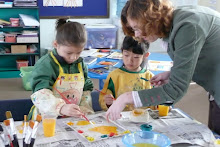
Questions, questions, questions. Six year old's ask questions every other sentence. They are curious about the world all around them. This is probably my favourite thing about teaching first graders, especially as their English grows and the questions begin to never stop.
"How do you spell help?" "When is it lunch time?" "Do we have to stop science class now? We're having fun!" "When will we have the fire drill?" " Do you spell heart h-e-a-r-t?" "Can I use markers to colour?" "Will we get to go to the treasure box tomorrow?" "Do I turn this into the box now?" "May I go to the bathroom?" What does brave mean?"
All these questions make for lots of opportunities to ask them questions to help guide their learning.
1. After you have explored the Questioning Toolkit websites, what types of questions do you generally use when you teach students?
In science and reading classes, we daily use esstential questions to guide our discoveries and to set purposes for our reading and our experiment outcomes. My students are all on different levels of English language learning, so clarification questions are also a daily type of question used in my classroom by both myself and my students. Grade one is where children are transitioning from kindergarten and into formal schooling. The overall goal of this year is independence in completing common routines and procedures. Thus, we have a lot of telling and planning questions.
2. What kind of questions would lead students to think critically and at higher levels?
Elaborating and inventive questions are two of many types of questions that can help primary grade children to think critically. Strategic questions also help guide them to think at higher levels while providing structure for them to not become discouraged easily.
3. What kind of questions would complement the integration of technologies in your classroom?
Elaborating questions would really complement integration of technology in my classroom. It is a natural step from ‘What does it mean?” to “What does this mean in relation to me?” and “How can I use this effectively?” Sorting and sifting questions allow my students to determine a technologies personal relevance to their lives.
Oh, and in case you’re wondering, the word brave in Chinese is 勇敢[yǒnggǎn].
Wednesday, March 17, 2010

Wednesday, March 10, 2010
Workshop Four Blog
My student reading selection this week was about Johnny Appleseed. One of the things that we discussed was Johnny’s life-style– he did not wear the same types of clothing as others, and he did not live in a house like others did. He did not even stay in one place for very long. He was different from others. This caused some people to not trust him although many people still liked him and knew him to be a good man.
I feel like I have the same type of relationship with technology and its uses for it in the classroom. Our school does not have a “technological lifestyle” similar to the schools of friends in my cohort. I cannot pull up a video on my interactive whiteboard or dazzle my students with a PowerPoint created to teach them about collective nouns. The technology I use is different from others, and at times I do not trust it because of these differences. This however, doesn’t mean that many other people can’t also use it or know it to be good for integrating into their classrooms.
The learning activities that I’ve completed for this education in technology course have opened my eyes to the many possibilities for their use in education. I have especially thought over the blogs and social networks idea and have found it very helpful. I would really like to integrate it as a form of student portfolio.
I feel like the work my students do is worthy of being displayed and could provide a link to other schools across the globe. Education in China is much different than education in Canada, or even education in Australia. All educational technologies have good application and if we combine these ideas and collaborate with others, I think I could really see something amazing come out of it. I’d love to be able to present how I’d used blogs in the classroom at a educator’s professional development conference, similar to the ICEC conference I attended in Hong Kong.
Wednesday, February 24, 2010
Workshop Three Blog
Maybe it's because I've lived in China for three years now or perhaps its because I'm used to first graders, but I was blown away by my friend Stephanie's fourth grade class. I visited to share and teach this past Wednesday as a guest speaker on Chinese New Year when I was still in the States. The students were eager to ask questions and one of them asked me (no, I didn't stage this question just so I could blog) what sort of educational technology we had in China. While my school doesn't have the same capabilities as her school, like interactive whiteboards, I am excited about the level of technology that is growing and being implemented each day. One of those technologies is podcasts.
Right now, I currently use audio to distribute my weekly reading selections. At first, I thought it would be useful to convert this into a podcast. Then I started to explore the possibilities of video podcasting. I think a video podcast would be much more useful to my classroom. For example, today we did an experiment in the class that is very simple and easy to replicate at home. We asked three essential questions about liquids and whether or not they would mix or separate. Students completed an observation sheet and part of their reading homework will be reflection on how their predictions turned out. However, I had four students (1/3rd!) of my class absent today. A video podcast would be an easy way to help students follow along with certain science labs at home when they were absent or to review before an exam.
Many of my students are also ESL students. They need many opportunities to practise their listening comprehension and critical thinking skills. A video podcast, even of a lesson that they were present for, would be a great way to help them develop their skills. However, I'm still curious as to how I would be able to best assess their learning when using this type of technology. I do not expect it to be a substitute for my classroom experience, merely a remedial or enrichment activity at this time.
Wednesday, February 3, 2010
Workshop Two Blog
I’m currently Stateside for Chinese New Year holiday. My friend Amy’s oldest son is in kindergarten this year. Yesterday we had an experience that was laden with technology. First off, Amy texted messaged me to see what I was doing. We had our entire conversation over SMS text messages and then she showed up at my door to pick me up.
So Davis and I went to his school and we did his Accelerated Reading. You sign the student into a computer program and after you read the book, you take a computer based comprehension test. Students earn ‘points’ for each book that they make a passing score on when they take a test. This process is simple. It’s natural. In fact, when we were done testing and reading about five books Davis and I picked out a ‘fun’ book to read that he wouldn’t be required to test on. It was a book on Volcanoes. It took him until halfway through the book for him to realise ‘Wait, I don’t have to test on this book, do I? Can you make a volcano with me?” The concept of reading a book without a computer-based component was something he wasn’t quite used to doing.
It all seems very commonplace and not out of the ordinary to me, until I start to think about it. My first-grade students are also a part of this culture now – worlds without technologies are non-existent to them. This makes the job of me the teacher, very important. It is up to me to make sure that they learn how to interact with it so they are prepared to interact with everyone else who is using it.
• What do you expect are the students’ cognitive outcomes when the students use technology?
I guess I expect that my student’s are able to use higher order thinking skills. I want them to be able to problem solve and to not be frustrated. I want them to be able to communicate, using technology, how they use computers, Internet and programs to do daily activities. I expect them to cognitively remember how to do these basic tasks; to they can focus on the process of creating rather than worrying about how to create. I see this a lot in my kid’s writing. This year, my kids love to write. They beg me to give them free writing time in their journals. As a former 8th grade English teacher, this makes me ecstatic and I usually comply. However, most of them are ESL students and have not yet learned how to spell words that are unfamiliar to them. It sometimes causes them problems. They get ‘stuck’ in the figuring out how to spell that they lose their idea of what they were writing about. I don’t want a similar situation for them when it comes to using technology in content area subjects.
• What do you expect are the students’ affective outcomes when the students use technology?
One of my favourite traditions is my airplane book. Yes, buying a book at the airport (especially if you’re in a country that doesn’t speak English) can get expensive. Yes, I could just put a book on my Kindle for iPod touch, and it would be less bulky….
But ever since I’ve had my passports at the ripe age of 9 months, I’ve had my airplane book every time I travel. On my way home, I picked up two books in the Beijing airport, one of them being Thomas Friedman’s The World is Flat. I’m only 137 pages into his explanation of the history of digital-technology advances and I’m fascinated. Here’s a quote from his book that grabbed so much I had to underline it.
“Once a standard takes hold, people start to focus on the quality of what they are doing as opposed to how they are doing it” (pg 84).
I think this sums up exactly what technology will do for our students. Many of us as teachers, and even our students to a degree, are in the process of trying to figure out how they will produce or use software. I know when I plan my lessons, my main focus is on how I can make the projector work and be set up and the website not be blocked and my students actually gain something out of it. I’m challenged to move beyond that. Once technology in education is standard, my students will be affected in a way that goes far beyond the mechanics of figuring out HOW to produce something and they can really begin to focus on WHAT they are making. This affective outcome will revolutionise not just our students but also the world in which they live everyday.
Thursday, January 21, 2010
EDU554 Workshop One Blog
It's a rare moment of silence in my classroom. The smart cookies are in computer class down the hall, so I thought it would be appropriate to do my first blog entry about how I can integrate technology into what I'm already doing.
Once again, I can see the difference between this generation and my own. I'm not that old, and I grew up with a fair amount of emergent technology that makes me open minded about the progress we are making (Twitter aside) and a person who uses technology in my every day life.
I was sitting the reader's circle with them talking about how I used to play outside and when it was time for supper, the ways I knew I needed to come inside. Usually it was my mother or sister shouting 'CHRISTINA! DINNER'S READY!". Some of my friends had whistles, or triangles and bells that they would ring and we could hear throughout the neighbourhood. If I was playing, and the street lights came on, I knew -- shouting or not -- that it was my curfew time and I was to head home.
My kids looked puzzled at me, so I took their bait and asked "Why are you guys looking at me funny?" "Miss L, why did your mother shout? Shouting is so LOUD", my smart cookies replied. "Why didn't your mom just call you on your iPhone?" (no, I'm not kidding. My first grader asked me this.) Here's what I found out: They don't go outside. They do their homework and then they play computer games or play with their Wiis and Nintendo DS. They do what I do with Facebook -- staying connected while I am in China and my friends and family are spread out all over the world. But they do it without giving it a second thought.
How do you currently integrate or plan to integrate technology into the existing curriculum?
Currently in my class, I am figuring out how to make podcasts of my weekly reading selections. Right now, I just export the file as an mp3 and I email it to my parents. I want to figure out how to do this as a podcast, so I save space on my hard drive and it can be accessed by more users than just my class and their parents. I have to be creative with the lack of resources my Chinese private school has. The Chinese teachers here don't even have WHITEBOARDS, and I am part of an elite group of classrooms that have them installed and are not relegated to using chalk and blackboards. The reading curriculum is old, and the media resource CD-ROMs were considered a waste of money when it was purchased, so much of the supplemental matierals I am using I make myself. I don't mind doing it but I want to plan ways to integrate technology that is easier for ME to produce and gives the students the most benefit.
What motivated or will motivate you to include technology in your lessons?
Like I said previously, the lack of resources and budget really means I get to be stretched in ways that make me grow as a creative technological user. Eventually, if I can show the administrators the invaluable difference that having resources, books, computers, technology, etc integrated into the classroom can bring maybe they'll increase our budget. Maybe (this is a dream, but hey, DREAM BIG) I'll even have the projector mounted to my ceiling and ActivBoard that I had my first year teaching when I taught at Westside Middle School.
Monday, January 11, 2010
"Brain, it's time to speak English!"
I'm ignoring my students right now (they're in Chinese class) but they're lecturing the Chinese teacher about why he should use my Expo markers instead of the Chinese brand. I think I find it even funnier that I understand what they're telling him in Chinese.
They are exactly right, I think. My colourful array of dry erase choices are 好的!
They've learned something at least. :)
I can't think of anything else funny my smart cookies have done today, but its only 8:33 and I haven't had my coffee yet.
I just needed a test entry for my blog.
They are exactly right, I think. My colourful array of dry erase choices are 好的!
They've learned something at least. :)
I can't think of anything else funny my smart cookies have done today, but its only 8:33 and I haven't had my coffee yet.
I just needed a test entry for my blog.
Subscribe to:
Posts (Atom)